Collaborative robotics · Industrial case study
Collaborative Robotic Assembly
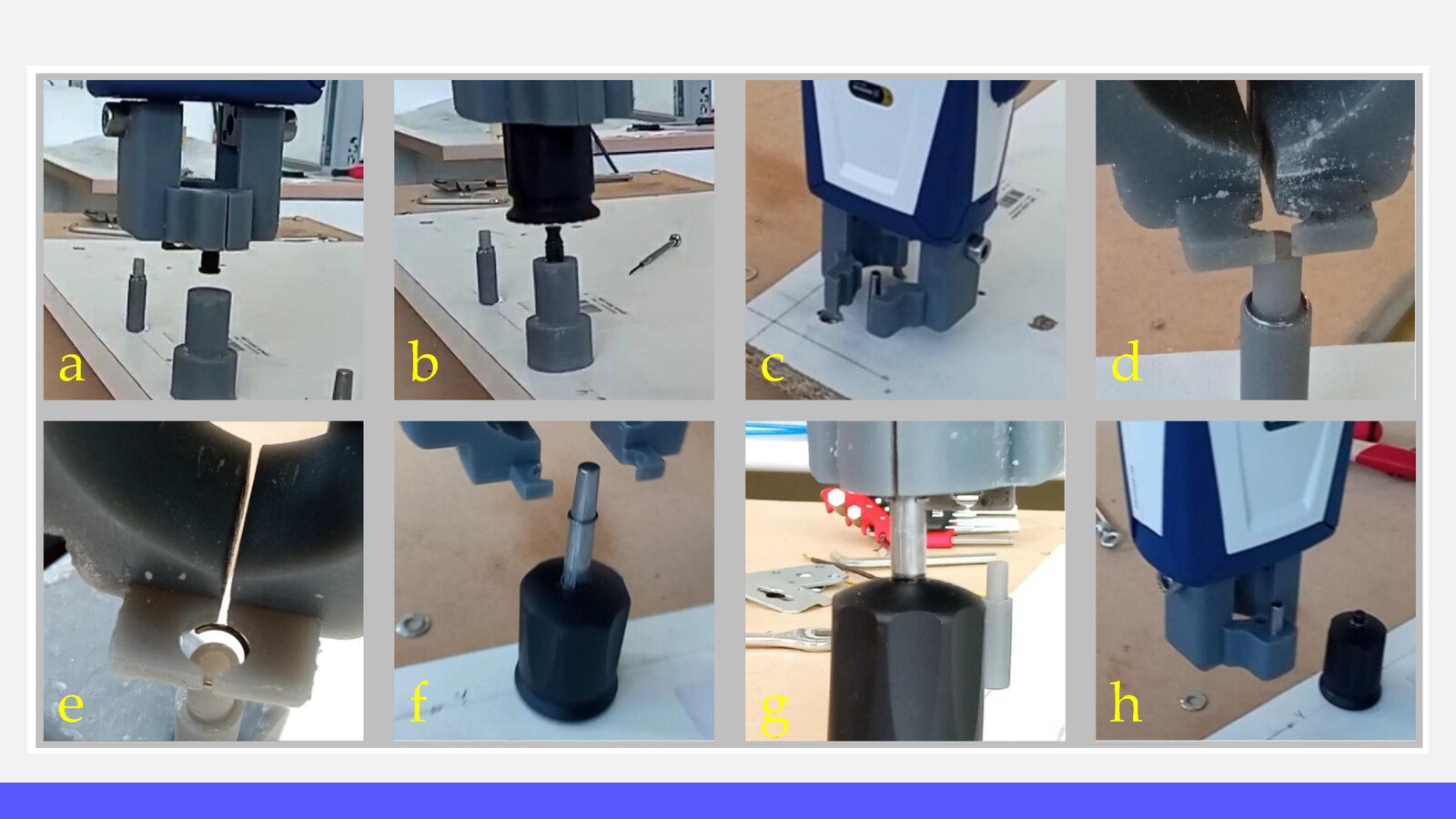
A FANUC cobot, custom printed fingers and a 9 millimetre retaining ring meet in a sequence of grasping, alignment and insertion.
Technologies
- FANUC CRX
- TP language
- SCHUNK EGP C
- Siemens NX
- SLA printing
Platform
FANUC CRX 10iA/L
Tooling
Custom SLA fingers
Observed cycle
50 s robot, 15 s manual
Precision lives in the smallest part
A cap, a magazine, a guiding cone and a retaining ring pass through one robot gripper. The ring measures 9 millimetres across and about 0.7 millimetres in thickness.
At that scale, alignment, friction, vibration and timing become visible in every movement. The assembly sequence turns a familiar bench task into a study of geometry and touch.
My contribution
I led the methodology, FANUC programming, experimental investigation and analysis, contributed to the system concept and developed the technical documentation and visual material.
The robot programme and the gripper geometry evolved together through CAD, SLA printing and repeated physical trials.
01
Break the manual process into robot actions.
02
Design multifunction fingers around four different components.
03
Manufacture the tooling in resin through SLA printing.
04
Refine positions, speeds and pauses through physical trials.
What the cycle revealed
The robot completed the sequence in about 50 seconds, while the manual sequence took roughly 15 seconds. The timing made the influence of tooling, component geometry and process design easy to see.
The experiment points towards assembly systems where parts, tools and robot motions are shaped together from the first sketch.
Explore further
- Collaborative assembly study, Eng, 2024.
- Fine assembly study, I RIM, 2023.
- CAD and demonstration material, GitHub.