Industrial vision · Feasibility study
Computer Vision for Surface Defect Detection
Light moves across polished aluminium, revealing patterns that a compact vision pipeline can turn into an inspection signal.
Technologies
- Python
- Darknet
- YOLOv4 tiny
- CUDA
- Data augmentation
Material
Reflective aluminium
Study
26 source images
Target test
15 FPS on the target GPU
Light becomes data
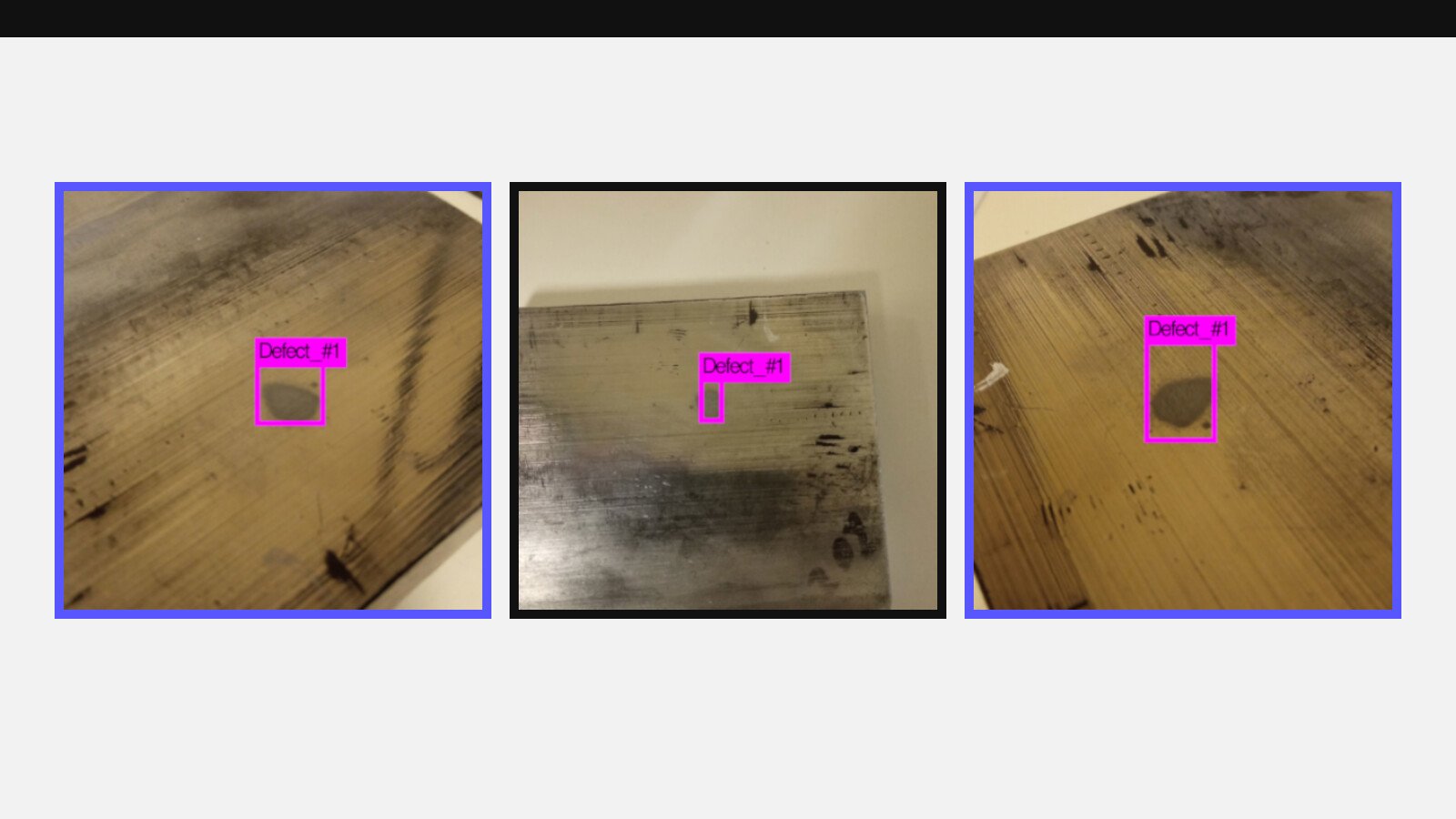
Polished aluminium changes character with every light and viewing angle. Faint unfinished regions emerge through highlights, texture and reflection.
The study began with 26 source photographs. Annotation and augmentation transformed that small visual collection into a focused experiment in industrial inspection.
Building the detector
I led the dataset design, annotation workflow, model configuration, software, validation, analysis and publication.
Compact Darknet networks connected image quality, augmentation, training time and the available computing power within one practical workflow.
01
Capture aluminium samples under changing light.
02
Annotate regions where polishing remains incomplete.
03
Compare compact Darknet detectors within a fixed training window.
04
Return the model to the target computer for inference.
From training to inspection
YOLOv4 tiny produced the strongest result in the comparative study. In the related custom network experiment, GPU inference reached 15 FPS on 416 by 416 images, while CPU inference reached 2 FPS.
The surface becomes a live engineering signal, opening a route from visual inspection towards adaptive robotic finishing.
Data, code and papers
- Dataset and defect detection study, Machines, 2024.
- Architecture comparison, IEEE/ASME MESA, 2024.
- SPADD dataset and model weights, GitHub.