Robotics around people · Research programme
TIAGo for Rehabilitation
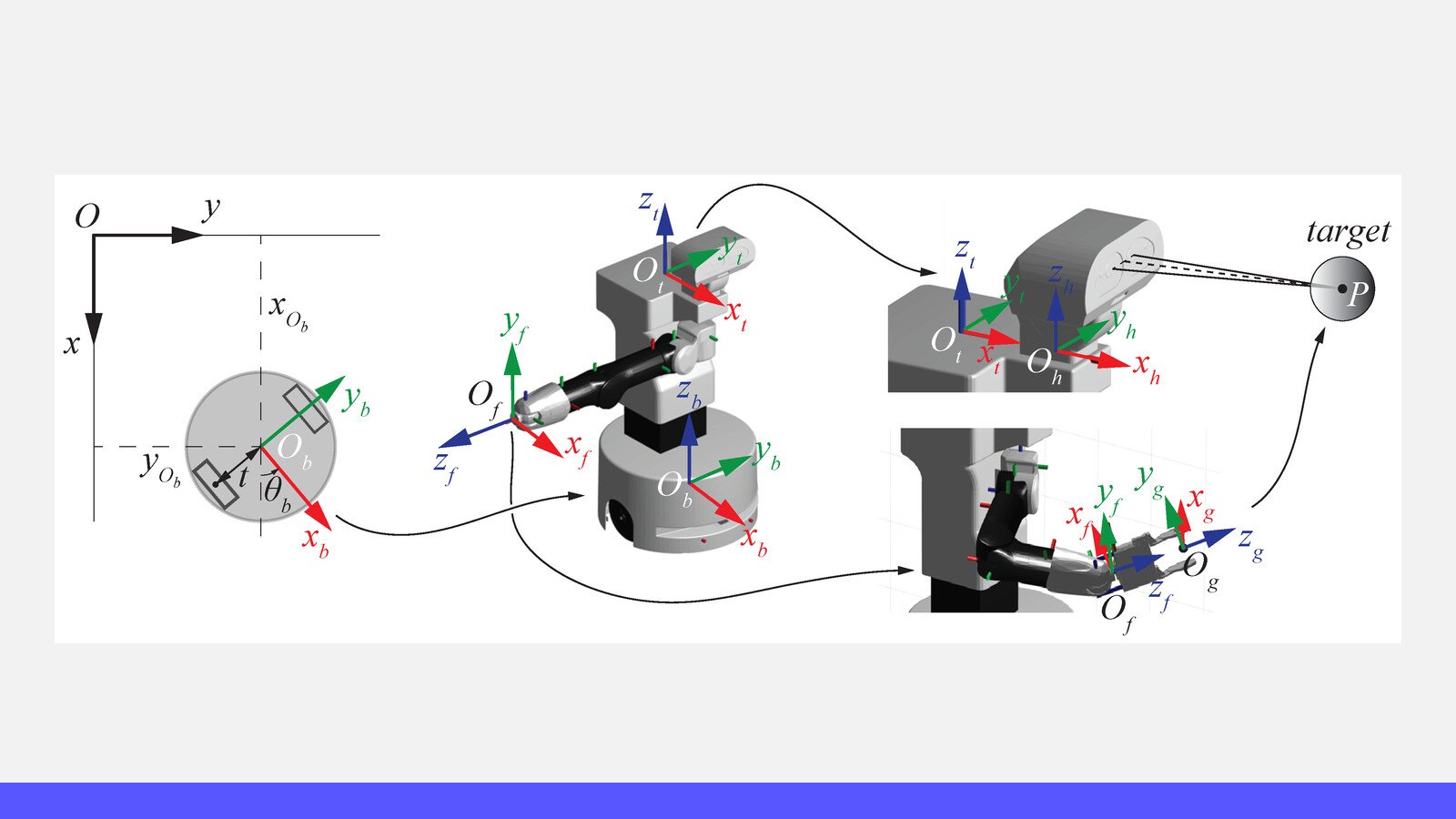
A human gesture travels through multiple camera views, three dimensional reconstruction and robot kinematics, then returns as movement in TIAGo.
Technologies
- ROS
- NVIDIA DeepStream
- MediaPipe
- RGB triangulation
- Gazebo
- OptiTrack
Field
Rehabilitation robotics
Pipeline
RGB views to robot joints
Validation
OptiTrack, simulation and lab trials
A gesture becomes a trajectory
An arm rises in front of the cameras. A few moments later, the same gesture appears in the movement of TIAGo.
Multiple RGB views reconstruct the shoulder, elbow and wrist in three dimensions. The trajectory is scaled to the robot, filtered and carried through its redundant kinematics.
My contribution
I developed the motion pipeline across kinematic modelling, markerless perception, RGB triangulation, trajectory retargeting, ROS integration, simulation and experimental validation.
The work grew through a sequence of studies, from posture optimisation and rehabilitation exercises to real time gesture mimicry and comparative motion tracking.
01
Observe the gesture from complementary RGB views.
02
Reconstruct anatomical points in three dimensions.
03
Scale the movement to the geometry of TIAGo.
04
Refine, smooth and send the motion through ROS.
TIAGo in motion
Watch the physical robot follow a human gesture, then look inside the workspace where two camera views meet the robot model.
A research line in motion
OptiTrack reference data, MATLAB analysis and Gazebo experiments made it possible to compare human and robot motion from several viewpoints.
Each study adds another layer to the same idea, a robot that can observe movement, interpret its structure and answer with a gesture of its own.
Explore further
- Posture optimisation study, Robotics, 2024.
- AI enabled rehabilitation framework, IEEE/ASME MESA, 2024.
- Real time gesture mimicry, ASME IDETC/CIE, 2025.
- Markerless upper limb motion tracking, MetroXRAINE, 2025.